What’s In Our Food? Ingredient Labels Explained
| 1 min read
00:00
00:00
About the Show
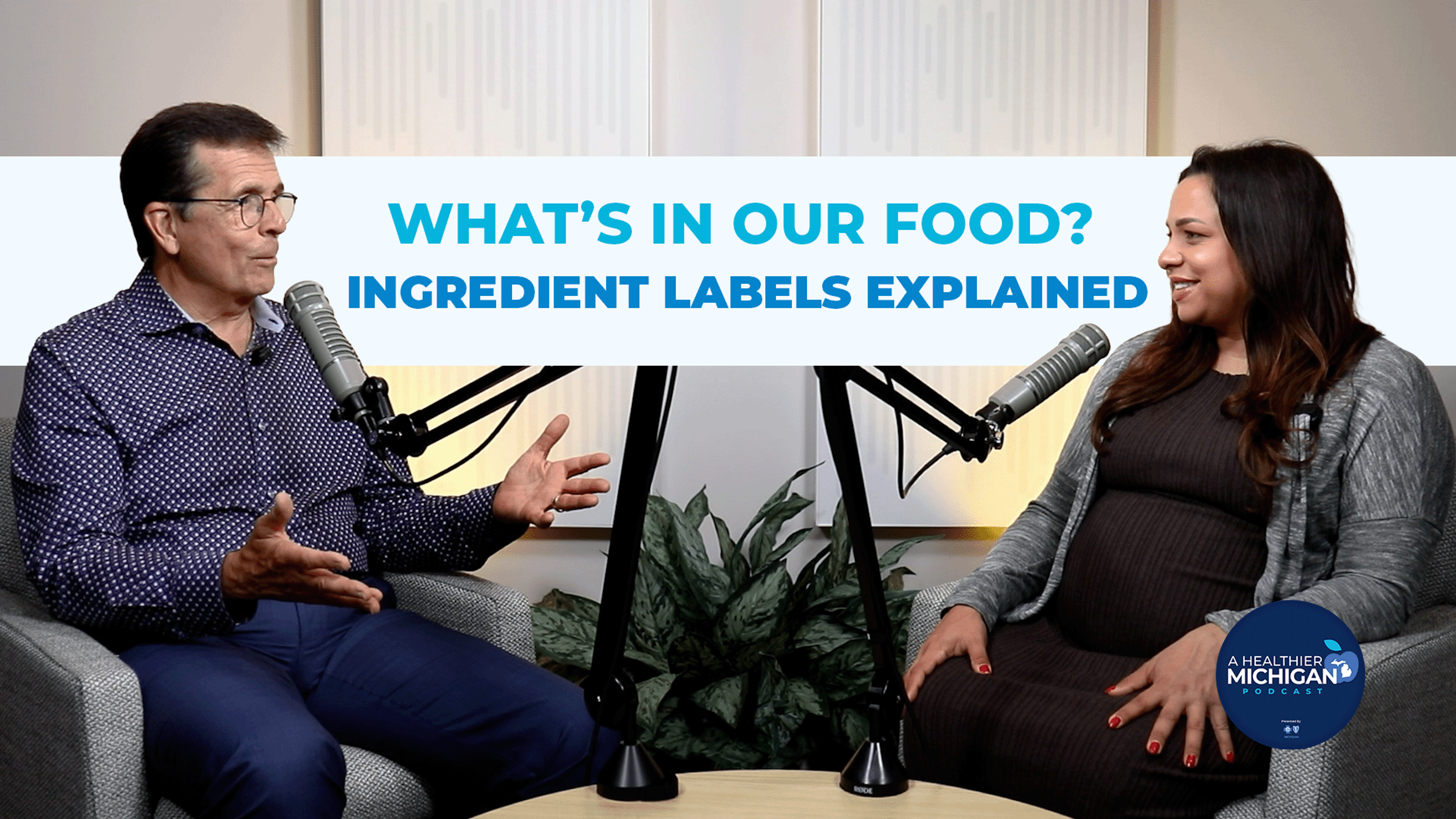
Ascorbic acid, enriched flour, monosodium glutamate… all of these are ingredients that can be found in your food, but are they good for you? On this episode, Chuck Gaidica is joined by Registered Dietitian Shanthi Appelö to explain some of these difficult-to-pronounce ingredients, why they matter and give you tips on checking those ingredient lists.
In this episode of A Healthier Michigan Podcast, we explore:
- Ingredient lists
- What’s going on with these names?
- What are we adding to our food?
- What ingredients should we avoid?
Transcript
Here is the full transcript of this episode. You can listen to the audio version on streaming platforms or watch on YouTube.
Chuck Gaidica: Natural flavors and enriched flour, ascorbic acid and sodium benzoate. What's that? If you've ever looked at the ingredient list on a package and thought, what does any of this actually mean? You are not alone. Food labels can feel overwhelming, especially when ingredient names are long, scientific, or unfamiliar.
Chuck Gaidica: But here's the important thing. An ingredient being difficult to pronounce doesn't automatically make it unhealthy, and an ingredient sounding healthy doesn't always mean it's good for you either. Today, we're talking about how to better understand the ingredients in foods we eat, what's worth paying attention to, and what's often misunderstood, and how to become a more informed shopper without fear, without food guilt.
Chuck Gaidica: Welcome to a Healthier Michigan podcast. I'm your host, Chuck Gaidica, and every other week we explore topics that help you live your healthiest life. Today we're joined by registered dietitian Shanthi Appelö, who's here to help us break down these ingredient labels, explain common food additives and share practical ways that all of us can make more informed choices at the grocery store.
Chuck Gaidica: It's great to see you.
Shanthi Appelö: Yeah. You too.
Chuck Gaidica: We were talking before we started. Enriched flour. It just sounds like somebody took the time to rich it up. It's got to be good for me. Yeah, so that I don't know if all of those are a trick, but when people look at the list and I am an ingredient label guy. But for me it's probably more, you know, calories or fat or something.
Chuck Gaidica: So when people look at an ingredient list, what should we all be paying attention to?
Shanthi Appelö: Yeah. So as a dietitian, one of the first things I look at is what's in the first three ingredients, because they are there by weight.
Shanthi Appelö: And so you know that the first ingredient is the greatest amount in that food. And so if I see sugar, for example, like when it's not really an oil thing, right. Or if it's like a vinaigrette and the first ingredient's water, I'm like, well, that's kind of sad. What am I paying for here?
Shanthi Appelö: We want to look at those ingredients just to see if they're kind of in the whole foods category.
Shanthi Appelö: That's going to be a good sign. You know, I want to get some grocery store sushi. Have you ever?
Chuck Gaidica: Yeah, sure.
Shanthi Appelö: We're not too good for that, right?
Chuck Gaidica: No, not at all. Because sometimes it's $5 Wednesday or something,
Shanthi Appelö: Something. Exactly. I love $5 Wednesdays, but I was shocked at seeing the ingredient list for that because I was thinking, here, I'm getting some sushi.You'd think rice, fish, maybe a sauce. It was longer than anything I've ever seen before. And so I think that's where you can kind of start thinking to yourself, what, like, why is it in there? And what should I do about it? So a lot of things that are in ingredient lists are there for a purpose, right?
Shanthi Appelö: Yeah. So for example, we may see things like preservatives, emulsifiers. They serve some kind of purpose. Maybe they are meant to protect the food so that it's safe for longer and it extends the shelf life. Maybe it's something that makes it more palatable. If you ever buy peanut butter, for example, and you want it to be creamy and smooth and not separate the oil from right.
Shanthi Appelö: Usually there are ingredients for that. So with that particular sushi decision, I was like, you know, there's no reason beyond that. The shelf stability of this, that this should be here. So I don't know, I didn't love it, you know.
Chuck Gaidica: Yeah. You were ready for it. I was in the mood. But, sushi.
Chuck Gaidica: To be fair. So if they're using the mock crab, which is whitefish, that's whatever they magic they do and it becomes that's like 20 ingredients. All enough sound,So they had to disclose what's in it even though it's a little piece of it, you know, in a California roll or something.
Shanthi Appelö: Right. Yeah. Yeah. And I hear a lot of guidance, Chuck, about, you know, like, you shouldn't buy things with an ingredient list so long.You should avoid things that you don't know how to pronounce. And that's not necessarily true, right? I think one of the more.
Shanthi Appelö: Like one of the better examples of this is how you said enriched flour, right? What is it enriched with? Oftentimes it's extra vitamins and minerals and things like that that we need that we maybe don't get enough of in natural foods. So we enrich foods with it. Same with, you know, milk, vitamin D helps us, milks, you know, that kind of thing.Yeah, exactly. They're great alternatives now because they've got the calcium.
Shanthi Appelö: Something that maybe people don't know about are some vitamins have just really scientific names. And then they'll show up in there like what's Alfa Tocopherol I don't know what that means.
Chuck Gaidica: Ascorbic acid.
Shanthi Appelö: Yeah. See. Yeah.
Chuck Gaidica: Yeah. I mean that's and we're all like in the wintertime in Michigan. We're all like well I better pound some of that because
Chuck Gaidica: Yeah, yeah, yeah.
Shanthi Appelö: Alpha Tocopherol is vitamin E. And then we've got cyanocobalamin and that's B12. Something that gives us energy.
Chuck Gaidica: Say and I know they do because I've seen some of that. But why don't they just disclose it. Is that a government thing that imposes.
Chuck Gaidica: You need to give me the name I can't pronounce. Vitamin C. I'm like, oh, that's cool.
Shanthi Appelö: Yeah. Well, I think for one reason, let's say the cyanocobalamin, for example, the vitamin B12 that is the supplement form, one that isn't naturally occurring. So it kind of gives us a little bit more information. So, you know, anyways,
Chuck Gaidica: So that means that we also need to understand that we need to try to be a little more educated sometimes. So if we hit a, you know, something on a side of a package where maybe buying frequently, maybe it's worth searching it up to know.
Shanthi Appelö: Yeah, it can be.
Chuck Gaidica: I'm not scared of it or I don't stop buying it if it's really something that I like.
Shanthi Appelö: Yeah, and I think you can kind of tell by the food, right? If it's something like a morning oatmeal and, you know, it has a little bit of sugar at it and it maybe not, is so harmful.But then and harmful is the wrong word to use. But it may not be that bad, right? But if you look at something like a really ultra processed cake or something and you see all these ingredients, maybe we need to think twice.
Chuck Gaidica: So some of this stuff you were talking about are common ingredients. Some of them are preservatives. So there are multiple reasons why some of these things are in there and some of them are beneficial. I still am totally amazed sometimes because we don't eat a lot of processed bread at our house, and if we do, it's got seeds or wheat or something that my brain says it's healthier. I just go for it for a sandwich often. But I've realized it seems to last a lot longer than I recall bread used to.
Chuck Gaidica: Yeah,Know there's something baked into not the cake, but the bread. Yeah,
Chuck Gaidica: Right? And at the same time, I'm not having to go out every three days and buy a new loaf of bread either. So this balance. We're all trying to figure out the economy of it and our finances and shelf life and goodness for our bodies.
Shanthi Appelö: Exactly. It's a balance that I think you need to decide for yourself. You know, when we read about ultra processed foods, we see that it's not linked to great things. People who eat more ultra processed foods that are a higher risk for all kinds of chronic illnesses, type two diabetes, heart disease. We've seen like dementia linked.So many different things.
Shanthi Appelö: Something about ultra processed foods is that they don't exactly know why. What part of them makes them so harmful in the long term when you continue to consume them? I think with ultra processed meats, we kind of understand it a little bit more. But researchers, they wonder if it's, you know, the emulsifiers, the preservatives or a combination of all of them.
Shanthi Appelö: Right. And so it's hard to nail down. But there are ingredients that are naturally occurring that do service these things. So for example pectin that's found in fruit. It's used to thicken foods. Citric acid you know like you'll see that in lemon juice. But it's something that helps preserve food a little bit. So even if we see things like thickeners and yeah, maybe they're not from the most terrible of sources, but I think it's something to pay attention to. So I think when it comes to someone looking at an ingredient list, how should you look at it? I think looking for the Whole Foods in the first three ingredients. Unfortunately Nutella has like sugars, the number one ingredient.
Chuck Gaidica: Nutella is there's, a thread to many of our podcast episodes in there? Sometimes, right.
Shanthi Appelö: Yeah, I, I yeah I have an obsession. So anyways, that's all right. That's something we should look for. I think the length is something to take into consideration. And then I think a lot of what you said take into consideration your budget, how long you want it to last on the shelf and how it tastes too, because maybe you have a preference for one over the other.
Shanthi Appelö: I think it generally rule of thumb, the fewer ingredients, the less ultra processed it is. But we have to look at more than just the length of it to determine whether it's ultra processed, because generally that just means that it's in a very different shape than it would have been found in nature.
Chuck Gaidica: Yeah, yeah. And are there any.
Chuck Gaidica: You've mentioned quite a few, but are there any other misconceptions, things that pop to your mind that we sometimes make assumptions about that are not necessarily bad for us?
Shanthi Appelö: Well, I think something that I've noticed that when people need read nutrition facts, labels, especially for diet foods, is like, oh, this has zero sugar, this has zero calories, this is zero.
Shanthi Appelö: Everything. Well, how does that really work? Right? Probably water is going to be the first ingredient, but something that manufacturers can do is to reduce the serving size to where it's a small enough amount to where it can register a zero. And so I think something that we need to look at in addition to all these things is just how big is the serving size, what nutrition am I getting in this amount that's suggested to me.
Chuck Gaidica: Have I got a good one for you? Because I just saw this.
Chuck Gaidica: Because we had a little celebration at the house. And if I have a can of whipped cream, the can and it says I can have two tablespoons of this white, fluffy, great stuff. And it's only 15 calories.
Chuck Gaidica: The serving size because my brain says, well, I can have six tablespoons. Yeah. And it's only 45, right. Exactly. But the serving size is what keeps it at fifth. They didn't say a cup. Yeah of course it's filled with air.
Chuck Gaidica: Yeah. So you're not getting as much cream. But it's funny you mentioned that because I just witnessed this as I looked at the can and I thought,
Shanthi Appelö: You felt bamboozled,
Chuck Gaidica: But I ate it anyway. Of course, you know?
Chuck Gaidica: So you mentioned this idea of zero sugar in something. And interesting when you look at the ingredients, what that means. If we're searching it up just by reading, what is it that's providing the sweetness. Because usually it's not something that isn't sweet.
Shanthi Appelö: Sweet. Yeah.
Chuck Gaidica: An artificial sweetener.
Shanthi Appelö: It can be so many different things.
Shanthi Appelö: And I think we think of sugar as the bad guy. But in general, it tends to be that sweetness is the bad guy because we want more of it. Our brain, you know, it triggers the reward system and so it can make us overeat regardless of what the source is, right? And especially some with the artificial sweeteners, non nutritive sweeteners, they could make you want even more because maybe you don't feel as satisfied as you would with something with sugar anyway.
Shanthi Appelö: So there's of course the non-intuitive sweeteners, the artificial ones, and the more natural ones like stevia, monk fruit, things like that. But then there's another category. Sugar alcohols. And that's something that still has calories. And it's digested a little bit differently than normal carbohydrates. So I think it's important to talk about because you'll still see the caloric value.
Shanthi Appelö: But manufacturers are allowed to call it zero sugar of course, because it's not real sugar. Now they get digested a little bit slower than than normal sugars and like maybe a little bit more like fiber, but not quite. Anyways, one thing to keep in mind though with those is that it's not like a freebie. They also could cause some uncomfortable aftermath in the bathroom if you eat too much. Yeah. Just because of how they're digested?
Chuck Gaidica: Yeah. So sugar, alcohol. I know that there's. I forget whichever brand it is, so I won't even mention it, but there's one that people often put in their hot coffee or tea or something, and now it's in other products. But the downside was that the sugar alcohols exposed to temperature and also that kind of thing.
Chuck Gaidica: Right? Yeah.
Shanthi Appelö: But do they taste as good?
Chuck Gaidica: and well, they do and I and I've tried other alternatives. I mean I know some people have to avoid sugar diabetics. Perfect example.
Chuck Gaidica: So they may still want to get an ice cream that doesn't have sugar, but it's got fat and they're okay with the fat. So I understand why some people may have to do it. But for the rest of us, I think it's a good one to look for.
Chuck Gaidica: And what does it mean? Yeah. Everyone loves a little sweet or salty something.
Shanthi Appelö: We love a little sweet tooth. But let's just, you know, not treat one as a more superior source than another. Like, it's not all of a sudden this, you know, virtuous food just because it doesn't have sugar, but it still has sweetness.
Chuck Gaidica: Ingredients are one thing that are so important to think about.
Chuck Gaidica: What would be some other takeaways from this conversation?
Shanthi Appelö: Yeah. Take a look at the ingredient list. Get familiar with certain types of words that may mean something that you don't traditionally think of.
Shanthi Appelö: For example, when something ends in the words- ose, typically that's some kind of sweetener. Maybe it doesn't just say sugar, right? And so become familiar with those kind of things that maybe we want to avoid a little bit for our health, and then don't take just the general guidance for what it is. Right. I can't buy this because the ingredient list is too long or this has foreign names.
Shanthi Appelö: So just kind of figure out what's important to you and don't let it just dictate your entire life for when you buy something.
Chuck Gaidica: I think that's all good advice, because, you know, when I said we can search things up, it seems like a daunting task.
Chuck Gaidica: But if it's a product you're eating on a regular basis,
Chuck Gaidica: Lot of, but it's something popping into your life, your kid's life. We owe it to ourselves to just do a little check. And once you know it, you know it. I mean, it's not like you to Google things every week, you know?
Shanthi Appelö: Right. And it's fun to be more informed, I think.
Chuck Gaidica: Yeah, it is, especially when it comes to sushi and Nutella. I'm just happy we've got a whole wholesome thing, an entree, followed by a wonderful dessert. It all works out. It's balance.
Shanthi Appelö: That's. That's what I like.
Chuck Gaidica: Good to see you.
Shanthi Appelö: Yeah, you too.
Chuck Gaidica: Yeah. Thanks so much. You know, reading ingredient labels is an important thing for being more informed. That's what we all want to be about our food.
Chuck Gaidica: It's easier and it becomes making choices. Something that's helped support life and health all the way around. We want to thank you for joining us on A Healthier Michigan podcast. It's brought to you by Blue Cross Blue Shield of Michigan. If you like our show, you want to know more. You can go online to A Healthier Michigan.org/podcast.
Chuck Gaidica: You can always leave a rating, a review podcast, on a podcast thing, and you can also give us comments if you like. And we would love to hear from you giving us suggestions about what we should talk about next time. Subscribe or favorite us. You can find us on YouTube. We hope we equipped you with tip 2 or 3.
Chuck Gaidica: That'll give you a healthier choice and a way to navigate life. Until next time, I'm Chuck Gaidica. Be well.