What Are Whole Foods? And What To Look For
| 1 min read
00:00
00:00
About the Show
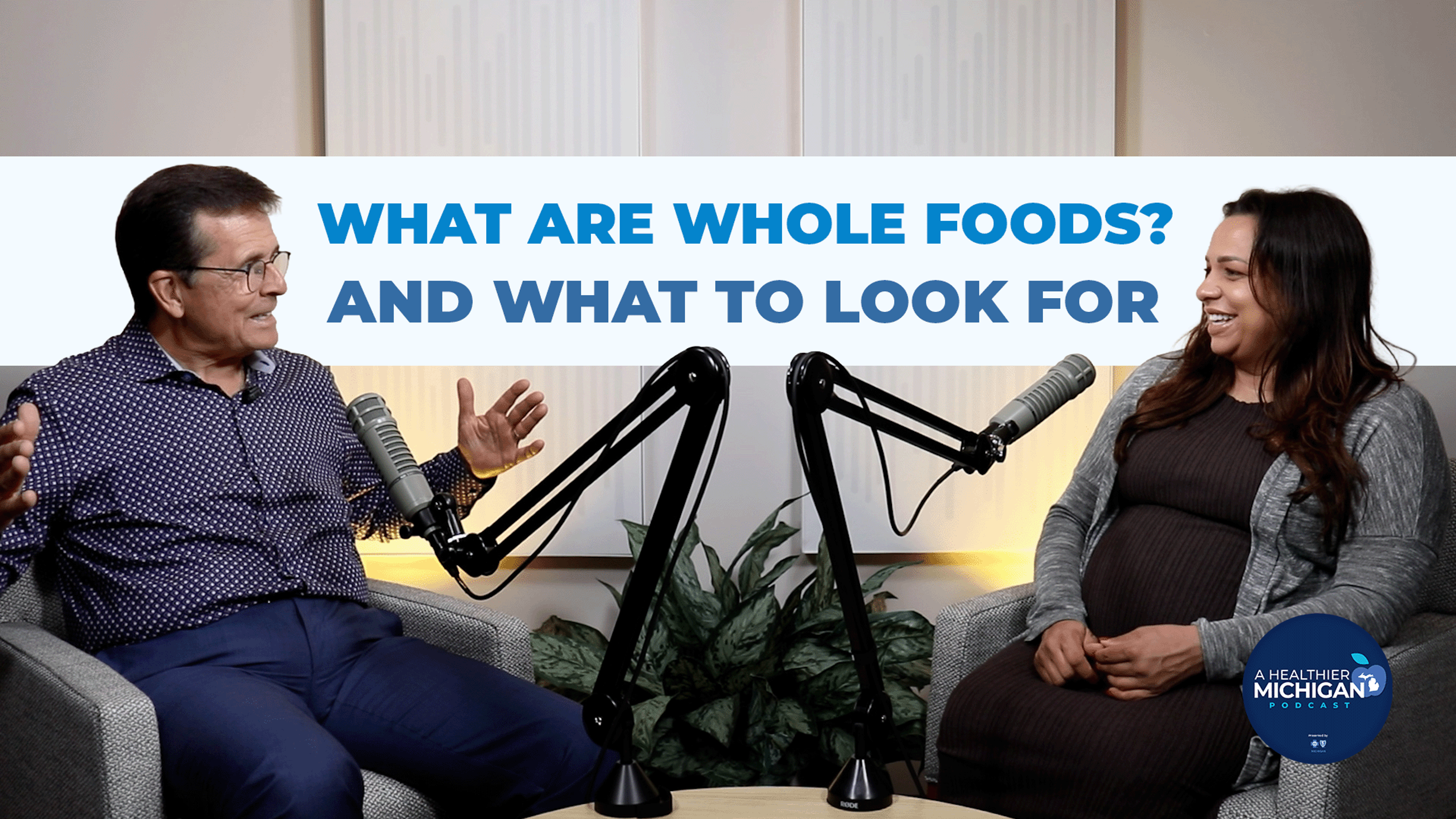
One thing we bring up a lot on this podcast is that you should be eating more whole foods, but what does that mean? What counts as a whole food? On this episode, Chuck Gaidica is joined by Registered Dietitian, Shanthi Appelö, to explain whole foods and no not the store, what the different types are, and how to know if you’re getting enough.
In this episode of A Healthier Michigan Podcast, we explore:
- What whole foods are
- Why they are good for us
- Why processed foods are bad
- How to eat more whole foods
Transcript
Here is the full transcript of this episode. You can listen to the audio version on streaming platforms or watch on YouTube.
What Are Whole Foods? And What To Look For
Whole Foods Explained: How to Reduce Ultra-Processed Foods and Make Healthier Choices
Chuck Gaidica:
Eat more whole foods. That's not an order, but it is one of the most common pieces of nutrition advice out there. But what does that actually mean? Whole foods have become a major part of conversations around healthy eating and balanced nutrition and long-term wellness. But with many, many packaged products marketed as quote unquote natural or healthy or clean, it can be difficult to understand what truly counts as whole food and why it matters.
Eat more whole foods. That's not an order, but it is one of the most common pieces of nutrition advice out there. But what does that actually mean? Whole foods have become a major part of conversations around healthy eating and balanced nutrition and long-term wellness. But with many, many packaged products marketed as quote unquote natural or healthy or clean, it can be difficult to understand what truly counts as whole food and why it matters.
Today, we're breaking down the basics of whole foods, how they differ from processed foods, and why focusing on more whole, nutrient-rich foods may support overall health.
Welcome to A Healthier Michigan Podcast. I'm your host, Chuck Gaidica. Every other week, we explore topics that help you live your healthiest life. Today, we're joined again by registered dietitian Shanthi Appelö to discuss whole foods, why they play an important role in our nutrition, and how people can make more informed choices when it comes to the foods they eat every single day.
Hello again! Whole foods, they named a whole store after them, didn't they? What exactly is whole food?
What are whole foods? Understanding the difference between whole and processed foods
Shanthi Appelö:
Yeah, it's, well, I think if we're going to think about whole foods as compared to something that's really ultra-processed, it's really good to understand what the NOVA system is. It's a classification system for how processed a food is.
Yeah, it's, well, I think if we're going to think about whole foods as compared to something that's really ultra-processed, it's really good to understand what the NOVA system is. It's a classification system for how processed a food is.
So, it has group one through four. Group one is where we have completely unprocessed and minimally processed foods. When I say unprocessed, you're picking the apple off the tree, right? Minimally processed, maybe you've washed the apple, okay. It's gone through some processing, right. Every bit of processing counts. Then in group two we've got the processed culinary ingredients.
This is going to be your butter, things like that. People don't eat it on its own, but they have some processing, obviously. And they're just ingredients that you keep in your house. Group three is going to be processed foods. Now, this is a term I hear all the time as bad. But processed and ultra processed foods are very different from each other.
Processed foods are going to be canned foods that are packed in brine and things like that. It doesn't necessarily mean unhealthy, but ultra processed foods are ones that look completely different than they do in nature. I like to give the example of an apple, canned apples, and then an apple pie. The apple pie doesn't look anywhere near how it did in nature.
We've added so many things to it, like sugar and fats. And then we've maybe added some things that make it more palatable, beyond just those ingredients, so that people want to eat more of them when they're sold. So when foods are kind of in the beginning parts of those, that's really good to think about it that way.
Chuck Gaidica:
But then you mentioned even in that category one, if I wash it, I'm starting to process it, but I'm going to wash it, right? I mean, that's not going to hurt you, but there's this scale that I've never heard of given a name, but it's really interesting, processing that opens up a whole giant realm of things, right?
But then you mentioned even in that category one, if I wash it, I'm starting to process it, but I'm going to wash it, right? I mean, that's not going to hurt you, but there's this scale that I've never heard of given a name, but it's really interesting, processing that opens up a whole giant realm of things, right?
Because sometimes I can take, you know, I heard the old phrase "parts is parts." Maybe you take all kinds of parts of chicken and grind it up and do it, and all of a sudden it's a nugget and we're going to sell it. Is that ultra processed or is that just processed?
Are processed foods always bad? Separating nutrition facts from food myths
Shanthi Appelö:
Well, I think it depends. If you buy it at the store in the frozen section, it's probably had a lot of ingredients added to it. But say you make it at home, maybe you buy some ground chicken. The only processing that's happened to it has been grinding it, right? Maybe you add an egg, that's not very processed. Maybe you add some panko breadcrumbs for texture and some spices, and then you sear it up.
Well, I think it depends. If you buy it at the store in the frozen section, it's probably had a lot of ingredients added to it. But say you make it at home, maybe you buy some ground chicken. The only processing that's happened to it has been grinding it, right? Maybe you add an egg, that's not very processed. Maybe you add some panko breadcrumbs for texture and some spices, and then you sear it up.
That's a different process, that's a different level of processing. And I think that's why when we make food at home, we can benefit so much. We've got a lot more whole foods in that. The panko is a whole food, the chicken is a whole food, the egg is, and combined, sure, they have some level of processing, but processing doesn't always necessarily mean bad.
Chuck Gaidica:
Well, and that's a really good point because oftentimes even on my tracking app, if I'm going to track food, if I type in "homemade meatloaf," there's a whole other list of others that you could buy at the store or otherwise, which I don't. But that word homemade means even though I have processed it, to your point with the chicken, it's not really necessarily bad.
Well, and that's a really good point because oftentimes even on my tracking app, if I'm going to track food, if I type in "homemade meatloaf," there's a whole other list of others that you could buy at the store or otherwise, which I don't. But that word homemade means even though I have processed it, to your point with the chicken, it's not really necessarily bad.
Depending on what ingredients I've used, which chances are great they're minimally processed like butter or something at best, right?
Why whole foods matter: The nutrients your body needs most
Shanthi Appelö:
Yeah, yeah. So I think we can benefit a lot from making things at home. But when we think about whole foods, one of the big things is nutrients, right? Usually, when we buy whole foods like fruits and vegetables and eggs and meats and things like that that are kind of in their original form, the nutrients are interacting with each other, which is great.
Yeah, yeah. So I think we can benefit a lot from making things at home. But when we think about whole foods, one of the big things is nutrients, right? Usually, when we buy whole foods like fruits and vegetables and eggs and meats and things like that that are kind of in their original form, the nutrients are interacting with each other, which is great.
For example, in an apple, we have the fibers, we have lots of vitamins and minerals and those kinds of things. So those are really great. Of course, anytime we cook something, some of those nutrients can be destroyed, but they can also be enhanced. If you take tomatoes, for example, when we're cooking tomatoes, we actually enhance the amount of lycopene that's in it.
It's an antioxidant. So anyways, there's a lot to think about, but I think what we're trying to get is just more whole foods in terms of nutrients when it comes to fiber, vitamins, minerals and just general goodness.
Fresh, frozen or canned: Which fruits and vegetables are healthiest?
Chuck Gaidica:
Now a question just popped in my mind, which is dangerous because there's a lot of space up there. So, if I go from broccoli, right, I've got it in my hands, it's broccoli, it's fresh, to frozen broccoli to canned something, or peas maybe is a better example. Do you come down as a dietitian on if I can't use the really fresh stuff, I'm on the go, got a big family, frozen versus canned. Is there a difference? Or as long as I'm having broccoli, that was the point, you know?
Now a question just popped in my mind, which is dangerous because there's a lot of space up there. So, if I go from broccoli, right, I've got it in my hands, it's broccoli, it's fresh, to frozen broccoli to canned something, or peas maybe is a better example. Do you come down as a dietitian on if I can't use the really fresh stuff, I'm on the go, got a big family, frozen versus canned. Is there a difference? Or as long as I'm having broccoli, that was the point, you know?
Shanthi Appelö:
Yeah. Generally, the nutrients that are in there, even when they're frozen or in a can, that's what we need to go for. I think go for what's convenient and always budget friendly for your family too.
Yeah. Generally, the nutrients that are in there, even when they're frozen or in a can, that's what we need to go for. I think go for what's convenient and always budget friendly for your family too.
Chuck Gaidica:
We've got a lot of prefix words here, whole with foods, ultra with processed. Ultra means, what? Is there literally a guideline that says when I get, is that that level four?
We've got a lot of prefix words here, whole with foods, ultra with processed. Ultra means, what? Is there literally a guideline that says when I get, is that that level four?
Shanthi Appelö:
It's the level four in the NOVA classification system. And you know, it just has certain ingredients like emulsifiers, preservatives, added sugar, maybe in the form of high fructose corn syrup. There's going to be a lot of different ingredients that you wouldn't find in nature. But to your point about the peas that are canned, that's still the whole food.
It's the level four in the NOVA classification system. And you know, it just has certain ingredients like emulsifiers, preservatives, added sugar, maybe in the form of high fructose corn syrup. There's going to be a lot of different ingredients that you wouldn't find in nature. But to your point about the peas that are canned, that's still the whole food.
Chuck Gaidica:
But I also wonder, when you have ultra processed, does that also include the method of processing, like high heat or other things? Or is ultra processed strictly related to the ingredients, or does it also include whatever they've done to mix it all together and it comes out a cake?
But I also wonder, when you have ultra processed, does that also include the method of processing, like high heat or other things? Or is ultra processed strictly related to the ingredients, or does it also include whatever they've done to mix it all together and it comes out a cake?
Shanthi Appelö:
It can be a mixture of both, but it is more about the ingredients.
It can be a mixture of both, but it is more about the ingredients.
Chuck Gaidica:
Yeah. So nutrition and nutrients that we're going to get, the benefits that whole foods provide, are critical, because it is really that phrase farm to table in a way.
Yeah. So nutrition and nutrients that we're going to get, the benefits that whole foods provide, are critical, because it is really that phrase farm to table in a way.
Shanthi Appelö:
Yeah, when we look at the evidence, we see that what makes people live the longest is having these nutrients that are in whole foods, right? And having them often. That doesn't mean that you can't go and have your ultra processed foods, but it's what we eat over and over again that really matters, right?
Yeah, when we look at the evidence, we see that what makes people live the longest is having these nutrients that are in whole foods, right? And having them often. That doesn't mean that you can't go and have your ultra processed foods, but it's what we eat over and over again that really matters, right?
So I think if you're someone who tries to incorporate some fruits and vegetables in your life every day, shooting for somewhere around five, that's a good place to start. And then, of course, there are other whole foods that aren't just fruits and vegetables. Think your yogurt, lean proteins like chicken and fish and things like that.
Chuck Gaidica:
I wonder, and I don't know the statistics, maybe you do, five fruits and vegetables a day. I love an apple and I love vegetables, but that still seems like a high bar has been set for all of us to try to achieve five different or even five apples. I mean, it just seems like a high bar.
I wonder, and I don't know the statistics, maybe you do, five fruits and vegetables a day. I love an apple and I love vegetables, but that still seems like a high bar has been set for all of us to try to achieve five different or even five apples. I mean, it just seems like a high bar.
Shanthi Appelö:
Yeah. So this is if it were me in my life as a dietitian, right? It might be that for breakfast, I'm having my Greek yogurt. And then every morning I'll put, like, a handful of strawberries and, like, do it with my butter knife, just like you do, so that there's a perfect strawberry in every bite. Do do do do do, sound effects now.
Yeah. So this is if it were me in my life as a dietitian, right? It might be that for breakfast, I'm having my Greek yogurt. And then every morning I'll put, like, a handful of strawberries and, like, do it with my butter knife, just like you do, so that there's a perfect strawberry in every bite. Do do do do do, sound effects now.
Chuck Gaidica:
Yeah. You're so good at them.
Yeah. You're so good at them.
Shanthi Appelö:
So I've got one serving of fruit right there. And then maybe for a snack, I'm having an apple with some peanut butter. There's my two fruits. At lunch, maybe I'm making something like an open face sandwich. And I love just layering on slices of tomato, lettuce, onions, stuff you can grab.
So I've got one serving of fruit right there. And then maybe for a snack, I'm having an apple with some peanut butter. There's my two fruits. At lunch, maybe I'm making something like an open face sandwich. And I love just layering on slices of tomato, lettuce, onions, stuff you can grab.
Chuck Gaidica:
Yeah.
Yeah.
Shanthi Appelö:
So maybe that counts as one. Generally, a cup is what we're looking for. And then for dinner maybe I'll have two vegetables. Maybe I'll have something that's sautéed, think green beans that are sautéed in some kind of Asian inspired sauce. And then on the side I'm having a little salad. So I think there's a way that we can incorporate it.
So maybe that counts as one. Generally, a cup is what we're looking for. And then for dinner maybe I'll have two vegetables. Maybe I'll have something that's sautéed, think green beans that are sautéed in some kind of Asian inspired sauce. And then on the side I'm having a little salad. So I think there's a way that we can incorporate it.
And when we're going out to eat, it's a good idea to think about, hey, maybe I can have one healthy thing and maybe I'll have one vegetable. And it doesn't have to be perfect every day, but it's just something that we should keep top of mind. You can exchange the fries for other vegetables, right?
Chuck Gaidica:
I mean, you know, you can say, do you have broccoli or green beans today? Do you have some, I've got a summer medley. Awesome. I mean, you can do it. It's not necessarily always the go-to, but yeah, it is a thing you can do.
I mean, you know, you can say, do you have broccoli or green beans today? Do you have some, I've got a summer medley. Awesome. I mean, you can do it. It's not necessarily always the go-to, but yeah, it is a thing you can do.
Shanthi Appelö:
And maybe if you do want the fries, you have your summer medley, but maybe someone at the table wants to share a side of fries with you.
And maybe if you do want the fries, you have your summer medley, but maybe someone at the table wants to share a side of fries with you.
How to spot ultra-processed foods at the grocery store
Chuck Gaidica:
Yeah. So, if we're not just reading the ingredients, and I don't say "just" to be demeaning here, but is there a way for us to see foods or understand the signs that something is ultra-processed without even reading the ingredients? What are some tips about that?
Yeah. So, if we're not just reading the ingredients, and I don't say "just" to be demeaning here, but is there a way for us to see foods or understand the signs that something is ultra-processed without even reading the ingredients? What are some tips about that?
Shanthi Appelö:
It's about how the food looks compared to how it would look in nature. Like if it's packaged and it doesn't need to be refrigerated, and it's something that's not like cereal, right? But you're like, oh wow, this is like a whole meal with protein. And it has animal protein in it and yada yada yada, and it's at room temperature. That's a little bit of a red flag. So thinking about how things are stored and that kind of thing. Also thinking about foods that have a lot of ingredients, of course, you would read that on the list, but when you go down the granola bar aisle or the protein bar aisle, you're going to see things that are just not just oats and a little bit of sweetness.
It's about how the food looks compared to how it would look in nature. Like if it's packaged and it doesn't need to be refrigerated, and it's something that's not like cereal, right? But you're like, oh wow, this is like a whole meal with protein. And it has animal protein in it and yada yada yada, and it's at room temperature. That's a little bit of a red flag. So thinking about how things are stored and that kind of thing. Also thinking about foods that have a lot of ingredients, of course, you would read that on the list, but when you go down the granola bar aisle or the protein bar aisle, you're going to see things that are just not just oats and a little bit of sweetness.
Chuck Gaidica:
Right. So that's another thing to look at. I know when I stare at a store bought birthday cake at a kid party, I know that's ultra processed. I know from beginning to end that's probably not, you know, and even if I went to a full size bakery, it's probably still ultra processed frosting.
Right. So that's another thing to look at. I know when I stare at a store bought birthday cake at a kid party, I know that's ultra processed. I know from beginning to end that's probably not, you know, and even if I went to a full size bakery, it's probably still ultra processed frosting.
Shanthi Appelö:
But there are those times where you need to give yourself that little fun factor. Give yourself some grace. That little piece of cake once a year is not going to do anything, you know?
But there are those times where you need to give yourself that little fun factor. Give yourself some grace. That little piece of cake once a year is not going to do anything, you know?
Chuck Gaidica:
Yeah.
Yeah.
Shanthi Appelö:
And that's so relevant because more than two thirds of the average adult's diet in the US is made up of ultra processed foods.
And that's so relevant because more than two thirds of the average adult's diet in the US is made up of ultra processed foods.
Chuck Gaidica:
Wow.
Wow.
Shanthi Appelö:
Yeah. So what you're saying is, hey, a little bit of birthday cake here and there, but when it starts making up most of your meals, when you're going through the drive thru and say you've bought a burger and you left it out on the counter, the next day it looks the same, or years later it looks the same, that's not great for our health. And if we're making those choices over and over again in a day, that's what makes the difference. It's not just picking something up here and there.
Yeah. So what you're saying is, hey, a little bit of birthday cake here and there, but when it starts making up most of your meals, when you're going through the drive thru and say you've bought a burger and you left it out on the counter, the next day it looks the same, or years later it looks the same, that's not great for our health. And if we're making those choices over and over again in a day, that's what makes the difference. It's not just picking something up here and there.
Chuck Gaidica:
So we've talked about foods that you can look at, foods you can hold, things you can eat. What about beverages? What about liquid contents? Can they be processed or ultra processed as well?
So we've talked about foods that you can look at, foods you can hold, things you can eat. What about beverages? What about liquid contents? Can they be processed or ultra processed as well?
Shanthi Appelö:
Certainly, sodas are going to go into that category. And there's lots of other drinks too, the energy drinks, even water, quote unquote, can be filled with stuff, right?
Certainly, sodas are going to go into that category. And there's lots of other drinks too, the energy drinks, even water, quote unquote, can be filled with stuff, right?
Chuck Gaidica:
Yeah.
Yeah.
Shanthi Appelö:
But I think here it's try to hydrate as much as possible with things that have minimal ingredients, and then leave those sugary drinks or other drinks to special occasions.
But I think here it's try to hydrate as much as possible with things that have minimal ingredients, and then leave those sugary drinks or other drinks to special occasions.
Chuck Gaidica:
You've given us this good advice. Maybe this is really great for sports type drinks, is it that some of the long words are in there because they may be vitamins in their official name, or they may be a supplemental version of a vitamin C or something, right? So I think we do owe it to ourselves to educate ourselves a little bit that that stuff that we're taking with electrolytes because we just jogged, it may not be bad because it's got a word we don't understand or we haven't seen before.
You've given us this good advice. Maybe this is really great for sports type drinks, is it that some of the long words are in there because they may be vitamins in their official name, or they may be a supplemental version of a vitamin C or something, right? So I think we do owe it to ourselves to educate ourselves a little bit that that stuff that we're taking with electrolytes because we just jogged, it may not be bad because it's got a word we don't understand or we haven't seen before.
Shanthi Appelö:
Sure. But oftentimes, a lot of those sports beverages are really sweet.
Sure. But oftentimes, a lot of those sports beverages are really sweet.
Chuck Gaidica:
Yeah.
Yeah.
Shanthi Appelö:
And so we're getting our sugar, we're getting sweetness from somewhere that's getting us used to, hey, I'm not going to be satisfied unless I have something sweet. And then beyond that, most people aren't going to need to replenish electrolytes after just a little jog.
And so we're getting our sugar, we're getting sweetness from somewhere that's getting us used to, hey, I'm not going to be satisfied unless I have something sweet. And then beyond that, most people aren't going to need to replenish electrolytes after just a little jog.
People who need to replenish electrolytes are those who work out really heavily. Maybe they're marathon runners, things like that. Maybe they're working out for an hour and a half at the gym or working out in extreme heat. So the general person doesn't really need,
Chuck Gaidica:
You’re saying I sold a bill of goods by marketing people? Is that what you're telling me?
You’re saying I sold a bill of goods by marketing people? Is that what you're telling me?
Shanthi Appelö:
They do a great job. Yeah, they have their jobs for a reason.
They do a great job. Yeah, they have their jobs for a reason.
Chuck Gaidica:
Right, right, right. So for long term health, why, wrap it up here, I guess, in a way, why are whole foods so important for our long term health? Because every once in a while, a hot dog or an ice cream cone, if it's just every once in a while.
Right, right, right. So for long term health, why, wrap it up here, I guess, in a way, why are whole foods so important for our long term health? Because every once in a while, a hot dog or an ice cream cone, if it's just every once in a while.
Shanthi Appelö:
Yeah, yeah. We love that at the ballpark. So think about it like this, ultra processed foods, especially when they make up a great amount in our diet, are linked to a higher risk of certain cancers, type 2 diabetes, heart disease, dementia, depression, even how we feel in our mental health. So it's got kind of a laundry list of things that can happen as we grow older.
Yeah, yeah. We love that at the ballpark. So think about it like this, ultra processed foods, especially when they make up a great amount in our diet, are linked to a higher risk of certain cancers, type 2 diabetes, heart disease, dementia, depression, even how we feel in our mental health. So it's got kind of a laundry list of things that can happen as we grow older.
Simple ways to eat more whole foods every day
So when we make consistent choices like that, it's not great for us. On the flip side, we see that eating lots of whole foods, including fruits and vegetables, lean proteins, things like that, we benefit from it. We see people live longer lives, healthier lives, and just feel better overall.
Chuck Gaidica:
Yeah, that's good stuff. Is there one takeaway, just one thing that you would say today, an action item that we could all focus on when it comes to this idea of processed or ultra processed foods?
Yeah, that's good stuff. Is there one takeaway, just one thing that you would say today, an action item that we could all focus on when it comes to this idea of processed or ultra processed foods?
Shanthi Appelö:
Yeah, I think when you're evaluating your meal, whether it's breakfast, lunch or dinner, think about a way that you can incorporate some kind of whole food where it's not all ultra processed.
Yeah, I think when you're evaluating your meal, whether it's breakfast, lunch or dinner, think about a way that you can incorporate some kind of whole food where it's not all ultra processed.
Chuck Gaidica:
Okay. Do French fries at fast food place qualify because it's a vegetable? Do I get any kind of points on that at all?
Okay. Do French fries at fast food place qualify because it's a vegetable? Do I get any kind of points on that at all?
Shanthi Appelö:
No.
No.
Chuck Gaidica:
You're laughing. Okay, never mind. I won't ask that question. Good to see you.
You're laughing. Okay, never mind. I won't ask that question. Good to see you.
Shanthi Appelö:
You too. Thanks, Chuck.
You too. Thanks, Chuck.
Chuck Gaidica:
Whole foods, you know, they don't have to be a complicated choice. Whole foods can just be something that are with you every day. They're not restrictive. You can figure this out. Understanding what they are, how they fit into your balanced lifestyle, that's the key.We just heard that from Shanthi, and it can help all of us sustain nutrition choices over time. Thank you for joining us on A Healthier Michigan Podcast. It's brought to you by Blue Cross Blue Shield of Michigan. If you like our show and you want to know more, you can jump online atA Healthier Michigan .com slash podcast.
Whole foods, you know, they don't have to be a complicated choice. Whole foods can just be something that are with you every day. They're not restrictive. You can figure this out. Understanding what they are, how they fit into your balanced lifestyle, that's the key.We just heard that from Shanthi, and it can help all of us sustain nutrition choices over time. Thank you for joining us on A Healthier Michigan Podcast. It's brought to you by Blue Cross Blue Shield of Michigan. If you like our show and you want to know more, you can jump online atA Healthier Michigan .com slash podcast.
Give us a review or rating. You can also leave comments there. Let us know what you think our next show should be about and what kind of topics we should cover. Always subscribe to us and tell your friends. You can check us out on YouTube as well. We hope we equipped you with a tip or two today to make for healthier choices in your everyday life.
Until next time.